The AI Search Handbook
$29Instant access to the complete 391-page PDF through a private signed download link.
Buy PDF for $29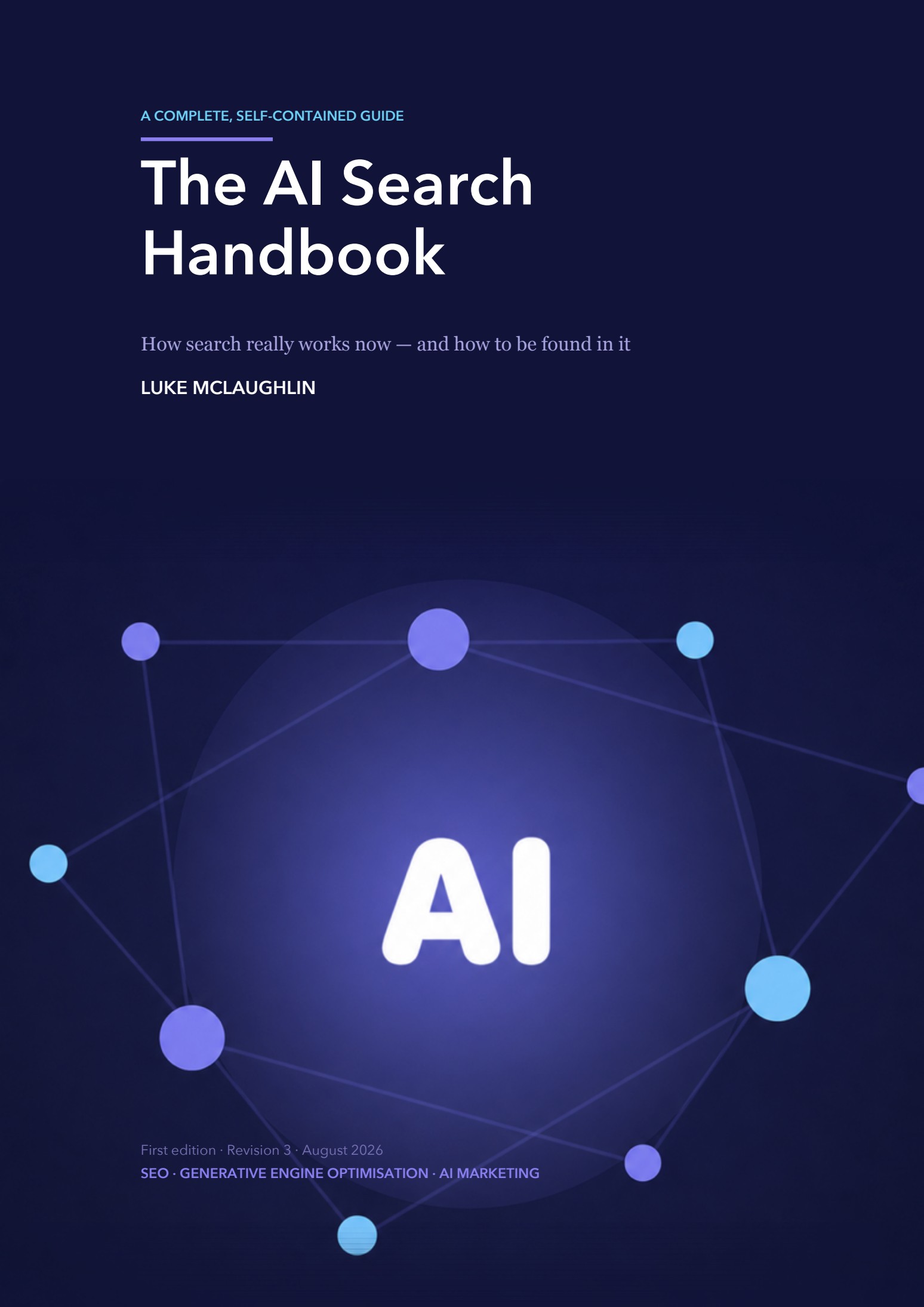 AI Search Handbook
PDF book$29 instant signed download
AI Search Handbook
PDF book$29 instant signed download
The AI Search Handbook is the complete, self-contained guide to being the source an AI assistant names. It explains the machinery underneath — how retrieval, chunking and citation actually work — then turns it into practical craft you can apply without a technical background.
Why readers buy it
Most writing about AI search is either panic or a list of tactics with a six-month half-life. This is neither.
The AI Search Handbook is a complete training path from traditional marketing into Generative Engine Optimisation. It does not assume a technical background and it does not require any other source: every concept it depends on — how language models work, how retrieval and chunking operate, why a crawler cannot read your prices — is explained inside the book. It is deliberately unexcited. Where the evidence for a practice is strong, it says so. Where a widely repeated tactic has been contradicted by data, it says that too, names the study, and shows you how to judge the next claim yourself.
The curriculum
Each part builds on the one before it. Parts I and II explain how AI search actually works; everything after that is craft.
Inside the PDF
Eleven pages from the book, at full resolution. Open any one to read it properly — arrow keys turn the page, and you can zoom to actual size.
11 of 391 pages · every diagram in the book is original
How it teaches
Every chapter opens with objectives and closes with a summary and self-check questions. All 172 questions have worked answers at the back, so you find out whether you understood it or only think you did. Forty-six original diagrams carry the mechanics for visual learners.
A single company runs through all 62 chapters as a continuous worked example: a Leeds coffee-equipment retailer whose editorial traffic fell 34% when AI Overviews started answering the questions its guides were built to win. You see what they did, in order, including the fixes that failed and the sprint they wasted. It is a composite rather than a client, and the book says so plainly on its second page.
Free GEO guides
Focused, answer-first articles adapted from the handbook and checked against current primary platform documentation.
How GEO extends SEO, what changed, and the five gates between publication and citation.
Technical GEOAI crawler robots.txt guideWhich bots matter, how to allow them, and why a permissive robots file is only the first gate.
ContentHow to write content AI search can citeAnswer-first sections, explicit entities, evidence and passage-level structure.
Questions
No. It is written for marketers with no coding background, and every concept it depends on is explained inside it — including how language models work and why a crawler may not be able to read your prices.
Substantially the foundations are the same, and the book says so rather than pretending otherwise. What is new is that retrieval works at passage level rather than page level, which changes how you structure content, and that measurement works by sampling rather than rank tracking.
Partly, and it tells you which parts. Retrieval mechanics and entities change slowly. Products and percentages date fast, so every time-sensitive figure carries its date and source. Corrections are published at the repository linked inside the book.
A single 391-page PDF, typeset for screen and print. After Stripe checkout you receive a private signed download link in the browser and by email.
IndepApps — ten years of organic search, content and measurement work on technical B2B products, including multi-market international programmes. The book is that practice written down, not a survey of other people’s.
Book purchase
This checkout is for the PDF only. One payment, instant download, yours to keep.
Instant access to the complete 391-page PDF through a private signed download link.
Buy PDF for $29FulfillmentStripe